


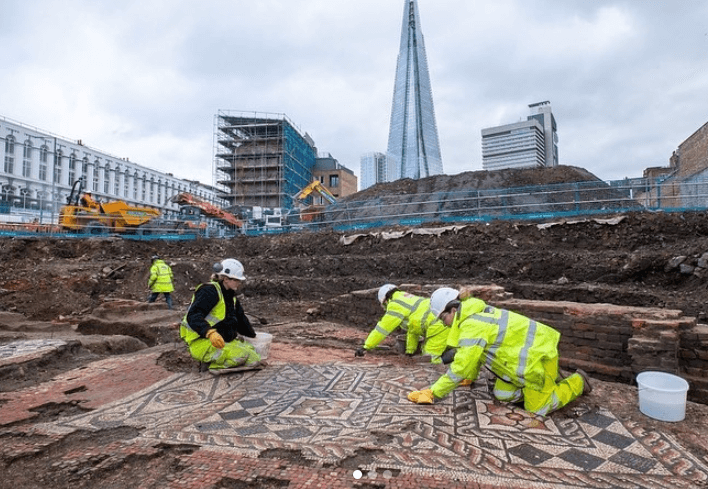
28 Feb Largest area of Roman mosaic found in London for over 50 years uncovered
Archaeologists from MOLA (Museum of London Archaeology) have uncovered an incredibly well-preserved mosaic that once decorated the floor of a Roman dining room.
Discovered a stone’s throw away from The Shard, experts have determined this to be the largest area of Roman mosaic found in London for over 50 years.
Excavations on the site have been taking place ahead of the construction of The Liberty of Southwark, a mixed-use scheme that is being jointly developed by regeneration specialist U+I (now owned by Landsec) and Transport for London (TfL).
Once completed, the Liberty of Southwark will provide new homes, shops, retail and workspace.
The recently uncovered mosaic includes two highly-decorated panels made up of small, coloured tiles set within a red tessellated floor.
The largest panel shows large, colourful flowers surrounded by bands of intertwining strands – a motif known as a guilloche.
There are also lotus flowers and several different geometric elements, including a pattern known as Solomon’s knot, made of two interlaced loops.
Dr David Neal, former archaeologist with English Heritage and leading expert in Roman mosaic, has attributed this design to the ‘Acanthus group’ – a team of mosaicists working in London who developed their own unique local style.
MOLA Site Supervisor, Antonietta Lerz, says: “This is a once-in-a-lifetime find in London. It has been a privilege to work on such a large site where the Roman archaeology is largely undisturbed by later activity-when the first flashes of colour started to emerge through the soil everyone on site was very excited!”
While the largest mosaic panel can be dated to the late 2nd to early 3rd century AD, the room was clearly in use for a longer period of time. Astonishingly, traces of an earlier mosaic underneath the one currently visible have been identified. This shows the room was refurbished over the years, perhaps to make way for the latest trends.
Neighbouring the mansio, archaeologists have identified another large Roman building, likely to have been the private residence of a wealthy individual or family. Traces of lavishly painted walls, terrazzo-style and mosaic floors, coins, jewellery and decorated bone hairpins all testify to the level of wealth enjoyed by the people living in this area 2,000 years ago.
Excavations on this site have been taking place as part of the wider regeneration of the area, set to be completed in 2024 with the opening of The Liberty of Southwark. This new development will sit between Southwark Street, Redcross Way and Union Street, offering contemporary workspace, 36 new homes, including 50% affordable housing, along with shops and restaurants. The scheme will also create new pedestrian routes, reinstating some of the medieval yards and lanes of historic Southwark.
The scheme has been designed by local architects Allies and Morrison as a varied collection of contemporary brick buildings, sensitive to the scale of their surroundings and full of references to the Victorian industrial and commercial architecture of the area. 15 Southwark Street, which dates from the 1860s, will also be restored as part of the development. The homes, commercial opportunities and public realm improvements provided by the scheme will become an important part of the community’s present fabric, without forgetting its past.
The excavation has also provided new training opportunities. MOLA, in partnership with Keltbray and TfL, delivered a two-week ‘Get Into Archaeology’ access programme for Londoners interested in learning more about construction and the work of professional archaeologists.
Henrietta Nowne, Senior Development Manager, U+I, said: “The Liberty of Southwark site has a rich history, but we never expected a find on this scale or significance. We are committed to celebrating the heritage of all of our regeneration sites, so it’s brilliant that we’ve been able to unearth a beautiful and culturally-important specimen in central London that will be now preserved so that it can be enjoyed by generations to come.”
The mosaics will be carefully recorded and assessed by an expert team of conservators. They will then be lifted and transported off-site, enabling more detailed conservation work to take place. Excitingly this will offer the opportunity to investigate the surviving traces of the earlier mosaic. Future plans for the public display of the mosaics are currently being determined in consultation with Southwark Council.